Saturday, June 9, 2007

Market day

Market day is always a cause for celebration. The entire city will congregate into a small area of town behind the taxi stand / tro-tro yard, ready to bargain, shop, and trade. People leave work early and forget their farms for one day. People from small neighbouring communities will travel to Savelugu with their produce and grains, walking for sometimes hours with their produce and grains towering on their heads. Children leave school in a rush to help their parents at their booth (if they go to school at all), or travel through the narrow isles with the little plastic sachets that I've become so familiar with calling out, "pure water! pure water!"

The brightest and most colourful materials are displayed, waiting for someone to buy them and bring them to a tailor or seamstress, both of which can be found just outside the market gates. People will call as you walk past with what they're selling, and the phrase, "kami na", or "come" is heard above everything else. I hear the ever present "Salaminga" rise above the children's laughter, and I stop to buy a mango from a small girl who is young enough to be afraid of the white woman's face.

I don't worry about pulling my pocket knife out to peel the mango, I've learned to eat them the same way as the locals. I squish the insides of the mango between my hands for several minutes, being careful not to break the skin. I pour some of my pure water only over the tip of the fruit, bite a small portion of the top off, and spit it aside. When I put my lips back to the opening and squeeze, I'm left with a sugary juice that is (almost) easy to drink. When the juice stops flowing, the skin can be further peeled apart to get at the pit, and you can then further eat the bits of fruit attached to the skin or the large hard seed on the inside. I'm not perfect at it yet, but it's wonderful.

I pull out my camera to capture the chaos, and kids start surrounding me, wanting me to take their picture, and won't leave me until I do. I snap some quick ones and they rejoice, coming to my side of the camera so I can show them what their digital selves look like, and they start to pose again before I say, "chama, chama!", or "go, go!"

I then carry my camera in my hand, winding through the isles, getting even more attention than before. The children are following me and I try to duck between two booths to put it back into my purse, but there's one more person that requests a picture, the lady in the booth that I ducked beside. She's selling beauty products, and proudly asks me to take her picture with her booth using body language and I try to respond in my broken Dagbani... but nothing makes her smile wider than when I start to lift my camera. The smile quickly disappears, though, when I go take the picture. She wants to look dignified with her business. I look for something to buy from her, but I have all the soap I need.

I look around anxiously, wondering how to find what I'm looking for in the disorder. I wanted to see the excitement for the first time, so the mother of the family that I live sent me on a mission. She needed a head of cabbage.

I'm seeing tomatoes, onions, okra leaves and more groundnuts than I would ever be able to eat. Mangos and oranges are plentiful, and the small sweet bananas I love are everywhere. I finally turn to a man that I heard speaking English and asked him to help. He grabbed my hand and pulled me through the crowd, behind booths, and around people until I didn't even know what direction I came from. He then stops quickly in front of me, almost causing me to crash into him, and announces proudly, "cabbage!" He then makes sure I am getting a fair price, shakes my hand, and then disappears back into the crowd.

The market was on Thursday this week, and continues on a six day rotating cycle. It's two days after the Tamale market day, which is on the same six day cycle, and so many of the proprietors travel from district to district hoping to sell to the more rural communities what they could not in the larger city.

The market in Tamale is more permanent. It's not just the small hut like structures that are used to shade the workers from the sun like in Savelugu, they have concrete walls and tin roofs and doors that you can shut and lock overnight. In Tamale, there will always be people open and selling even when it's not market day. In Savelugu, you can find some local fruit and sometimes a butcher, but the real excitement comes once every six days. That's when Ghana comes to shop.

Sunday, June 3, 2007

Answering questions

Sometimes I travel by tro-tro, but luckily there have been no goats on top. Tro-tros are like mini buses that travel from town to town that get stuffed to double what their capacity should be. When the tro-tro is starting to get full, people will come in through the windows to try to find that empty spot. The luggage on the top of the tro-tro can be piled as high as the tro-tro itself, and can also be strapped to anywhere they can tie rope.

I had to buy a large drum to hold my water in, and I had to take it from Tamale to Savelugu. They strapped it to the back of the tro-tro, and had a boy (maybe 12) stand on the bumper in the back and watch that it (among other things) didn't fall off. On most of the tro-tros the door is the same as on a minivan. On this particularly packed ride, they didn't close the door, and there were an additional five people that were standing out of the door, holding onto the roof rack. When I finally got to my destination, I was told my another passenger that I should pay the boy watching my stuff. I didn't ask him to watch it and risk his life... but I took the direction of by fellow passenger and gave him enough to buy a snack in the market.

As for language and communication... it happens. Ghana was colonized by England, so English in the national language. Anyone who has had any kind of formal education I can communicate with, so that pretty much means children of school age, most men, and some young females. The trick to talking to Ghanaians, though, is to SLOW DOWN, which has been quite the challenge for me. Other ways to enhance the communication is to adopt Ghanaian English... for example, when you're leaving a room that you'll eventually come back to, you say, "I'm coming," which is quite counter-intuitive to me, and when you're doing something a little bit at a time the phrase is, "small small."

Otherwise, I am learning Dagbani, the local language here, but I'm only learning "small small." I have someone at work that is now helping me with the phrases that I need to know the most, but unless I write it down I tend to forget fairly quickly. I know all the greetings and can make some very small talk, but I really want to learn more. I need to kick it up a notch! The other thing is that I'm going to some more rural communities in the next few weeks where the education is less available and the English is less frequent. I'm really going to spend some time on it this week.

The temperature? It's hot most days, but I'm finding myself getting more and more used to the heat. I've always been good with extreme heat anyway, so it's not too hard for me. I don't have a fan in my room, but there's a nice breeze that flows through my windows. There's a fan in my office. When it rains, it's often cool after... and by cool I mean maybe 20 degrees.

The people here have no concept of cold. They keep asking me what people wear outside in winter, and I have only one picture. I should have thought ahead better on that one.

My internet access is... sketchy. In Tamale there's internet, but it's dial-up and extremely slow. There's no internet at all in Savelugu, and I usually come into Tamale about once a week to download my emails and post a new blog entry. I try to answer my emails during the week on my laptop, and then do the send-download-upload dance all over again the following week. There's only a few places in Tamale as well, so they're usually pretty busy. The computers are also old, and so some webpages don't load. Again, my saving grace is my laptop; yet, I hate walking into the internet place and pulling it out of my bag. Western privilege again, and the people just see the white lady that has a shiny computer that she can bring with her everywhere. At the same time, I can do three times the amount of things that I want to do when I bring my laptop, so it's just a matter of managing what I need to do with the image of myself that I want to show. Most of the time I'm in a hurry to go back to my community, so I take the laptop.

I'm the only volunteer from my organization in Savelugu, and I only get to see the other volunteers every 3 weeks or so. This was one of those weekends, and it feels AMAZING to reconnect to the people that are going through the same things as me, and we can give each other amazing support. It's always so nice to see them again.

I'm going to leave some of the work that I am doing to another day and for another post, and hope that these answers are satisfying you. I love hearing from all of you and really love the comments. I'll talk to everyone again soon.

Next post I'll have more pictures, and I'm getting a second dress made. I can't wait!

Sunday, May 27, 2007

My compound

I have been in my room in Savelugu for over a week now, and I thought it would be good to show some of the things that I see every day.

First, there's always a tonne of kids that are running around the compound, even though there are only two that live there. They are Dennis and Lydia, aged 12 and 10 (I think), and they keep me laughing and running whenever I'm there. The mother, Alice, has really been taking care of me, and has accepted me as another daughter while I'm there, always making sure that I have eaten enough.

Yesterday I had to wash most of my clothing (I had waited until the last minute), and she watched me for a minute before tut-tutting and grabbing my shirt out of my hands. "Let me show you how." Another girl, Ayisha, is about 14 and is an apprentice for the mother, learning how to make wax print and tie-and-dye fabrics. After Alice seemed satisfied that I had learned how to wash more properly, Ayisha sat down beside me and told me I was taking too long, and started helping me, not even stopping when I said I could do it on my own. She laughed and asked me how I survived in Canada. I told her that I had a machine to do it for me, and her eyes grew wide and her hands slowed for a minute. "You are very lucky." I didn't know what to say to that... because I am.

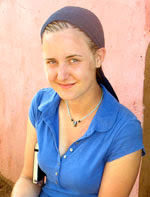
As you can see from the picture, I also got my first dress made. Colourful fabrics fill the market place just waiting to be tailored however you want them. The girl in the sparkly top is Lydia, and when we went to church today she sat on the back of my bicycle on top of the small rack that I have there. While during all my elementary school days the teachers preached about how unsafe it was, it is common practice here. The father was out of town with his NGO truck, and so if she was going to get to church, that was the only way to do it. I was dressed in my new dress, and instead of hearing the people on the street yell, "Salaminga" over and over again, they were silent in awe of the white girl in African dress with the small African girl on the back of her bicycle.

The front of my compound is a giant advertisement for Soap, something that Alice also makes. She has great plans to make the front of the compound a store where people can buy wax, fabrics, soap, and other miscellaneous goods that she already sells out of her house. She has drive, and I really admire her for it. Her husband makes a good salary working for an NGO, but she is continuing to strive for better, and take care of her children the best she can.

When I look out my window in the morning, I see a lot of green. It's beautiful, until the goats wake up and decide to start making noise right outside my window. It's probably not right outside my window, but that is what I'm deciding to believe. I live close the end of town, but it's a fairly small town that I can bicycle across in about 10 minutes if I don't stop to talk to anyone... which I normally do. So, I still live in the suburbs, despite moving to Africa. Savelugu is actually quite a wealthy little town for Ghana. It's just outside a major urban centre, and it's a major home for NGOs. They pump a lot of money into that town. Sure, there are still mud huts with thatched roof, but I'm starting to think that the thatched roofs are smarter than the tin that I have. Only the main road is paved, but everything is so close to the main road that it really doesn't matter. Many of the people that I work with live in Tamale and commute each day, something that shocked me at first; they are working for the district level government and living in a different district. It makes more sense to me now though... most people are transferred from district to district without their choice. Even when they worked in different districts, many of their families stayed in Tamale. Getting to work in Savelugu is one of the best assignments -- they no longer have commute to visit their families on weekends. They can see them all the time.

I share my compound with the family of four, a man that works for the electrical company, a mother hen and six baby chicks (along with some other random chicken bird type things that I can't figure out if they belong to the family or just steal the food), a puppy named Scooby, and small turtle that lives in the drain that I rarely see. It's loud, noisy, and there are always things happening... and I love it.

This was disorganized, but I hope it gave a small insight into my life thus far. Questions? Send me an email or post a comment. I'll try to tailor these posts to what people would like to hear about to make it the most interesting and educational as possible.

Sunday, May 20, 2007

Rain, rain go away! Come again another day!

When the rains come, it's really quite something.

The clouds come overhead, dark as night, completely blocking out the sun. The women in my temporary compound look at the sky, a small smile playing around their lips. The children laugh louder.

The winds pick up, slow at first, but then into a fury knocking around the clothesline, and the women and older children are making a mad dash to remove everything that was drying. I run out to help, but they are much faster than me and I struggle over a clothes-pin. They tut-tut and laugh at me, but then ultimately push me out of the way. The time is to short to worry about teaching the white girl.

A sock gets blown out of a child's hand, and I run after it, triumphant when I catch it, but I turn around to hand it off to someone and they are no longer there. I briefly look up and then turn to run towards my own room -- I could see a wall of water coming towards me as if the sky opened up, releasing everything it was holding.

I didn't run fast enough.

Within seconds I'm soaked to the bone, my capris sticking to my legs, my flip-flops filled with water, and my shirt hanging, much heavier than it should be. The sunscreen I had applied before I saw the sky drips into my eyes, and I finally reach my door. I grab a towel to wipe my face, and then just watch.

The rains are an amazing thing to watch, though I am stuck inside as long as they are here. I was awake with the sun, and was only minutes away from going to the market. It's only 9:00 AM, and I have been awake for hours, bathing, washing, and cleaning, getting ready for a full day ahead of me. That day may not happen, but I am content to sit at my window and watch the intensity of the storm.

Added later: Rain go away! I had things to do today, and I'm instead bound to my room! Rain go away! It's been 5 hours!

Thursday, May 17, 2007

The first things you notice...

Ghanaian culture is very different from Canadian culture, and in order to better understand some of the things that I'm going through, I thought I'd write out the ones that come to mind the most.

1) All food is communal. You can be walking into a service station to grab some water and if the person behind the counter is eating something (which happens quite a bit) then "you are invited" to join.

2) Water is bought in 500 mL plastic sachets for 500 cedies each, or about $0.06. There is a lot of waste, but that is the cheapest and safest way to buy water. There are many brands, but my favourite is "Aqua-ba", which is a clever play-on-words of "Akwaaba", which in the southern Ghanaian language of twi means "Welcome", and is proclaimed all over the airport. The satchels can be bought almost everywhere, and there will be many tables set up along the road with coolers. When you want to order one, you refer to it as "pure water", making sure you pronounce the 't'.

3) Walking is delightful, but not if you're in a hurry! Every child on the street will yell out, "Salaminga!" which means "white person", and will want you to great them. Similarly, many adults will call to you as well (usually with the morning, afternoon or evening greeting) as they would like to know where you have come from and why you are there. They then like to hear how you like Ghana, and laugh over your butchered Dagbani (the primary language of Tamale, the northern capital, and Savelugu, which is where I am working.)

4) Taxis have routes, and are shared. Most taxis in Tamale just travel up and down the main road, and you can hail them just by putting out a hand. They will stop and let you in, but there is often many people in the taxi already! The driver will continue to pick people up, and when you have reached your destination, you simply tell the driver to let you out here, (referring to him as 'driver') and he'll stop. Prices are fixed dependent on how far you are travelling. In inter-city taxis, there will usually be 4 people in the back, and 3 in the 2 bucket seats

5) People here are not content to call you by your given name. Every intern has been given a Dagbani name. Mine is Malititi (mal-i-tee-tee), which means "you will do it well for us."

6) Animals are everywhere. On my first day here I saw 3 cows walking in a line down the main road, and it is common to have your journey be stopped by a goat. All the goats apparently belong to someone, but how they are all accounted for I have no idea.

7) Any adult can discipline any child, any the child will respect them. Any adult can ask a child to do a chore for them, and they will do it. With age comes a lot of respect.

8) There is the road, and then a wide sidewalk for pedestrians, bicycles and motorbikes, and then an open gutter. The gutter can go from about 4-8 feet deep, and while you can jump over them quite easily, you do not want to misstep!

9) Fruit is plentiful. You can buy mango almost anywhere, as well as a lot of pineapple, bananas, and miscellaneous other fruit. People will either have small tables set up, or they will be in a large bowl on top of their head that they will walk around with.

10) The price of bananas fluctuates like oil does in Canada. It depends on the size, where they come from, how yellow or green they are, and how plentiful they are that day.

I haven't been here for a full 2 weeks yet, so I'm sure that I will come across many more things, and these will become common place. As I continue to learn and integrate, I will come across many things beneath these surface observations, and I know I will come to love many of these differences, though will get frustrated with the same amount.

This weekend I am finally moving from Tamale to Savelugu (though I have been working here now for a week), and I hope that I will continue to learn more.

Next step: get some clothing made!

Sunday, May 13, 2007

The day that lasted innumerable hours.

I woke up the Sunday morning the left (as I'm posting this it's now a week ago though it feels like a month ago) not knowing to be scared or excited, and instead I huddled under by blanket for a few moment pondering the thought that the day had come. The entire week I had joined Janna in her count down to take off, and the realization that "7 more sleeps!" had turned into the day of departure was slightly overwhelming; yet, I packed with the other Junior Fellows in a flurry of organized chaos, had breakfast with a member of the national office, and still managed to get out the door without forgetting anything. (at least, nothing that I've noticed so far.)

The 16 JFs that were flying to Ghana all piled outside of the EWB
training house taking pictures and saying goodbye to our Malawian
counterparts until it was finally time to go. We strapped on our
packs and made our way to the subway station, but things were never so real as when I turned the corner and lost sight of my residence for the past week. Gill yelled out, "we're going to Africa!" and the 5 of us travelling together cheered, but at the same time the butterflies in my stomach came alive, tears welled up in my eyes, and a giant smile broke out on my face. I was amazingly proud of my journey this week, and am only looking forward to more despite the fears that have come to light this year and throughout training.

Even as the plane took off from Toronto, a bunch of us linked hands
and cheered when we were in the air. There was no turning back, we
were on our way.

Yet, as I described in my last post, the journey is not always work,
and we get to have some fun too. We arrived in Milan, Italy for our
layover of exactly 8 hours deciding that we were not going to let this opportunity go to waste. We all took the train to downtown taking in the sites, we broke into small groups, and the four others that I was with had our sites set on the Duomo, a giant church in the middle of the city that took over 500 years to build. The hall was grand, the stained glass windows were amazing, and in true engineering fashion, we marveled about how they built it without all our modern machines.

We then trekked to the roof of the church (and realized how out of
shape we are with how quickly we were out of breath) and saw an
amazing view of the surrounding area. I kept having to remind myself that I was actually in Italy, and that it wasn't just a dream. It was surreal -- the trip was unplanned at best, and those few hours away from the airport (along with the espresso and gelato) made me realize a few things.
1. The group of people that I am with are extremely special people, and I am lucky to have shared that with them.
2. Things that are admired take a long time to build. I realized after that this is a pretty good metaphor for so many of the things that I am doing this summer. I cannot expect to learn Dagbani in a day, I cannot expect to have my office like me and trust me within my first week. These things will take time, and I cannot rush them.

I'm now somewhere over Northern Africa, (as I wrote this, it has taken me quite a bit of time to find internet) seeing nothing but clouds and too awake to sleep. The destination is only a few hours away and I am once again a flurry of emotions, but excited to see what I can do when my feet touch the ground.

Saturday, May 12, 2007

Pre-departure Learning Week

Pre-departure training is over. I can't believe that the week past
so fast, and that the people that I barely knew last Sunday I now know
intimately and can share some of my deepest hopes and fears with. The
learning challenged me, and made me challenge myself in ways that I
never thought to be possible.

I sometimes take EWB's mentality for granted. The group shares the
mindset that we can never stop striving to be a better person, and
that we will all help each other to reach the goals that we set for
ourselves. Feedback is the most valuable gift you can give someone,
and when you receive that feedback you embrace it. It is so easy to
be defensive and take it as an attack; yet, at EWB it is genuine and
someone is simply trying to help you on your own personal growth.

What an amazing organization to be a part of!

Luckily, though, it wasn't all work. On Monday night we started
experiencing cultural differences by having all the Junior Fellows in
our training group visit an Ethiopian restaurant while George and
Parker (the co-founders and co-CEOs of EWB) gave their opening
remarks. On Wednesday night we were put into small groups to prepare
presentations for Thursday morning, but we all went back to the EWB
house and made a large dinner of pasta complete with garlic toast and
wine before starting the presentations... it made for a late night,
but the growing feeling of community was well worth the lost sleep.
On Friday night the National Office brought in Ghanaian food so we can
become more accustomed to some of the local dishes. Most of the food
was fantastic, but the group mostly had trouble with the okra, which
is a vegetable that when it is boiled it turns into an alien slime
that never disconnects from the main bowl and can only be categorized
as a viscous snot. I think I saw it on an X-Files once. Saturday
night between the laundry and the packing, we still managed to all
gather in the common room, tell silly stories, and drive each other
nuts from mind games. The night ended with a bunch of us going to a
pub and laughing for hours before trying to find apple pie at a 24
hour supermarket. We were not successful, as it seems that no matter
how strong the craving for apple is, it will never materialize when it
is needed the most. (or, if it does, it appears at a price much
larger than our stipend.)

I never thought that I would be happy to be living in a house with 26
people, having 14 hour days of learning, calling being let off at 6:00
an "short day", and having the first lesson that I learned be "I don't
know anything," but the week was more amazing than I can put into
words, and I cannot believe that I was able to accomplish so much in
such a short amount of time.

Pre-dep is over... now the real adventure begins.